


Ronaldinho: The Beautiful Game’s Free Spirit
A journey through the highs, the chaos, and the shirts of football's most joyful genius.

There is a photograph of Ronaldinho receiving a standing ovation at the Santiago Bernabéu in November 2005, surrounded by Real Madrid fans applauding the man who had just destroyed their team. Nobody watching could quite believe it was happening. That is the effect he had. This is the story of how he got there, what happened next, and why the shirts he wore in that period are still some of the most wanted in any serious collection.
Porto Alegre to the World
He grew up playing futsal and beach football in Porto Alegre. His real name is Ronaldo de Assis Moreira. The nickname came from his size on the pitch as a kid, a small Ronaldo to separate him from the older one. By the time he was eight, people were already talking about what he could do with a ball. Grêmio gave him his first professional contract in 1998 while he was only 18 years old.
Paris Saint-Germain came in first. He spent two seasons there, steady enough but not yet the version of himself the world was about to see. Then Barcelona watched him at the 2002 World Cup and saw enough, they needed to sign him. He was twenty-two and he was moving to the best club in the world.
Barcelona and the Ballon d'Or
The move to Barcelona in 2003 changed everything. Frank Rijkaard built the team around him and for two seasons it was possibly the most entertaining football any club had played since the great Ajax side of the early 1970s. He won the Ballon d'Or in 2005. He led Barcelona to the Champions League in 2006. He was playing with a permanent smile and defenders genuinely could not work out what he was going to do next.
The moment that stays with people from that period happened at the Bernabéu on 19 November 2005. He scored twice in a 3–0 win over Real Madrid. At the final whistle, the home crowd gave him a standing ovation. Real Madrid fans applauding the opposition. That had not happened since Diego Maradona played there in 1983, and some argued it had not quite happened then either. Barcelona captain Carles Puyol said afterwards that he made them smile again. That was the precise right word for what he did.
The Wild Side
Toward the end of his time at Barcelona the stories started coming out. Late nights. Arriving to training in poor condition. Deco was said to be involved in the same pattern. The concern at the club was not only about Ronaldinho himself but about what this was modeling in front of a nineteen-year-old Messi who was watching everything at close range.
Rijkaard lost the dressing room across 2007 and 2008. Results fell apart. In the summer, Pep Guardiola arrived with completely different ideas about how the place should function. Ronaldinho was sold to AC Milan. The Barcelona era was over.
Massimiliano Allegri
"He arrived on time. But he came directly from the nightclub."
AC Milan and the Slow Fade
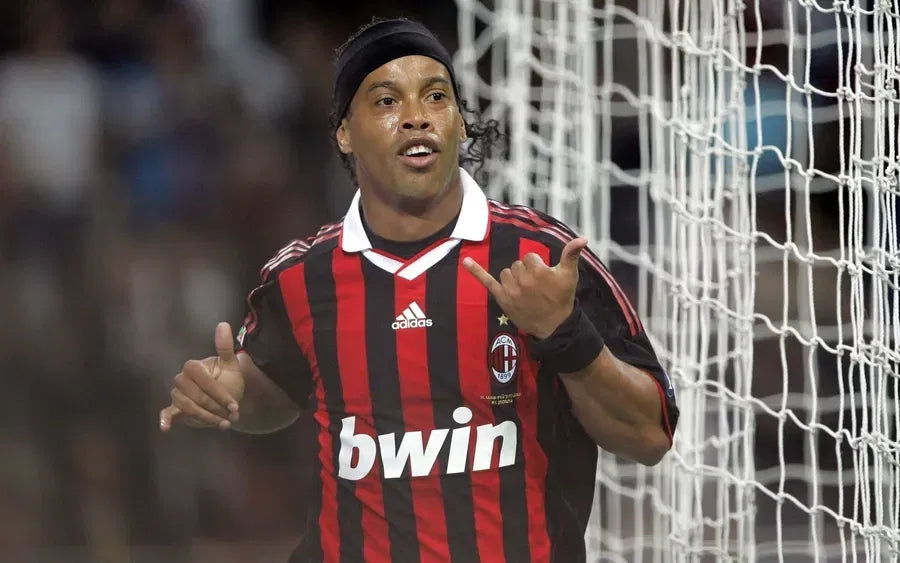
Milan got him for a reasonable fee and the early signs were good. The no look passes were still there. The free kicks still dipped over walls. But the version of himself that had terrified defenders at Barcelona was not quite the same player who turned up in red and black. The fitness was harder to maintain and the consistency that Guardiola demanded elsewhere was not something the Milan setup was built to enforce either.
Allegri coached him during part of that period and later said he would sometimes arrive having come directly from a nightclub. Milan gave him more patience than most clubs would have. By 2011 it was clear the European chapter was finished. He was thirty-one.
Flamengo and the Clubbing Clause
He went home to Brazil and signed with Flamengo. The contract included a clause that allowed him to go out twice a week without any consequences from the club. Flamengo accepted it because having him in the squad, even a reduced version of him, still pulled crowds and changed games. He was thirty-two and he was still Ronaldinho.
He kept his side of the agreement. One week he would score a free kick from distance that nobody in the stadium could quite explain how he had done it. The next he would be photographed leaving somewhere at four in the morning. Both felt entirely consistent with who he had always been.
Paraguay, Jail, and a Prison Pig
In 2020 he was arrested in Paraguay for travelling on falsified documents. Brazilian citizens do not need a passport to enter Paraguay at all, which made the whole situation genuinely difficult to explain. He served 32 days in prison.
Inside he organized football matches with other inmates, signed autographs for everyone who asked, and won a pig as the prize in a prison tournament. He was moved to house arrest in a hotel, eventually fined $90,000, and allowed to return home around five months after it had started. Even in prison, somehow, he was Ronaldinho.
The Shirts He Left Behind
For collectors, the Barcelona years produced the most wanted shirts. The 2004/05 Ballon d'Or season, the 2005/06 Champions League run, the blue away kits, the burgundy third shirts. The number ten with RONALDINHO above it in the Sporting ID font Barcelona used across that whole period. Those shirts are expensive now and they deserve to be.
The AC Milan shirts are genuinely underrated. He wore number 80 at Milan rather than ten, which makes them immediately recognizable. The 2008/09 home shirt and the third shirt from that season have a lower entry point than the Barcelona material and they tell a completely different part of his story. A slightly sadder one, but still his.

What Watching Him Felt Like
Ronaldinho is one of the few players whose shirts carry the game's mood rather than just his name. When you look at a Barcelona shirt from 2005 with his name on the back, you do not think about the titles or the statistics. You remember what watching him felt like. That is rare. Most players give you memories. He gave you a feeling.